
Why the Pfennig Coin Still Matters to Collectors
Small denomination, large narrative.
The German Pfennig coin served as the primary currency unit from the ninth century until the introduction of the euro in two thousand two.
Production Period | Denomination | Material | Weight | Diameter |
1948–2001 | 1 Pfennig | Steel with copper coating | 2.00 g | 16.50 mm |
1949–2001 | 2 Pfennig | Bronze before 1968 / Coated steel | 3.25 g | 19.25 mm |
1949–2001 | 5 Pfennig | Steel with brass coating | 3.00 g | 18.50 mm |
1949–2001 | 10 Pfennig | Steel with brass coating | 4.00 g | 21.50 mm |
1949–1950 | 50 Pfennig | Copper and nickel mix | 3.50 g | 20.00 mm |
Utilizing coated steel instead of solid metals reduced manufacturing expenses significantly.
Magnetic properties found in steel-based coins allow for rapid identification of the core material.
Material density directly affects the level of die wear during the minting process.
Mint Locations and Identification Marks
Every factory stamped a unique letter onto the coin surface to identify its origin.
Placement of the mint mark on West German pfennigs occurs between the stems of the grain.
A — Berlin
D — Munich
F — Stuttgart
G — Karlsruhe
J — Hamburg
Mintage volumes were distributed among these facilities with high variability.
Letter G appearing on coins often correlates with the lowest production numbers.
Scarcity regarding specific mint offerings triggers price increases during public auctions.
Auction Records and Statistical Data
Market pricing relies heavily on data gathered from public sales.
Specimens exhibiting Mirror Proof or Mint State 67 grades yield the highest financial returns.
50 Pfennig 1950 marked Bank Deutscher Länder instead of Bundesrepublik Deutschland — Mint G — €6500
2 Pfennig 1969 — Mint J — struck in solid copper — €3500
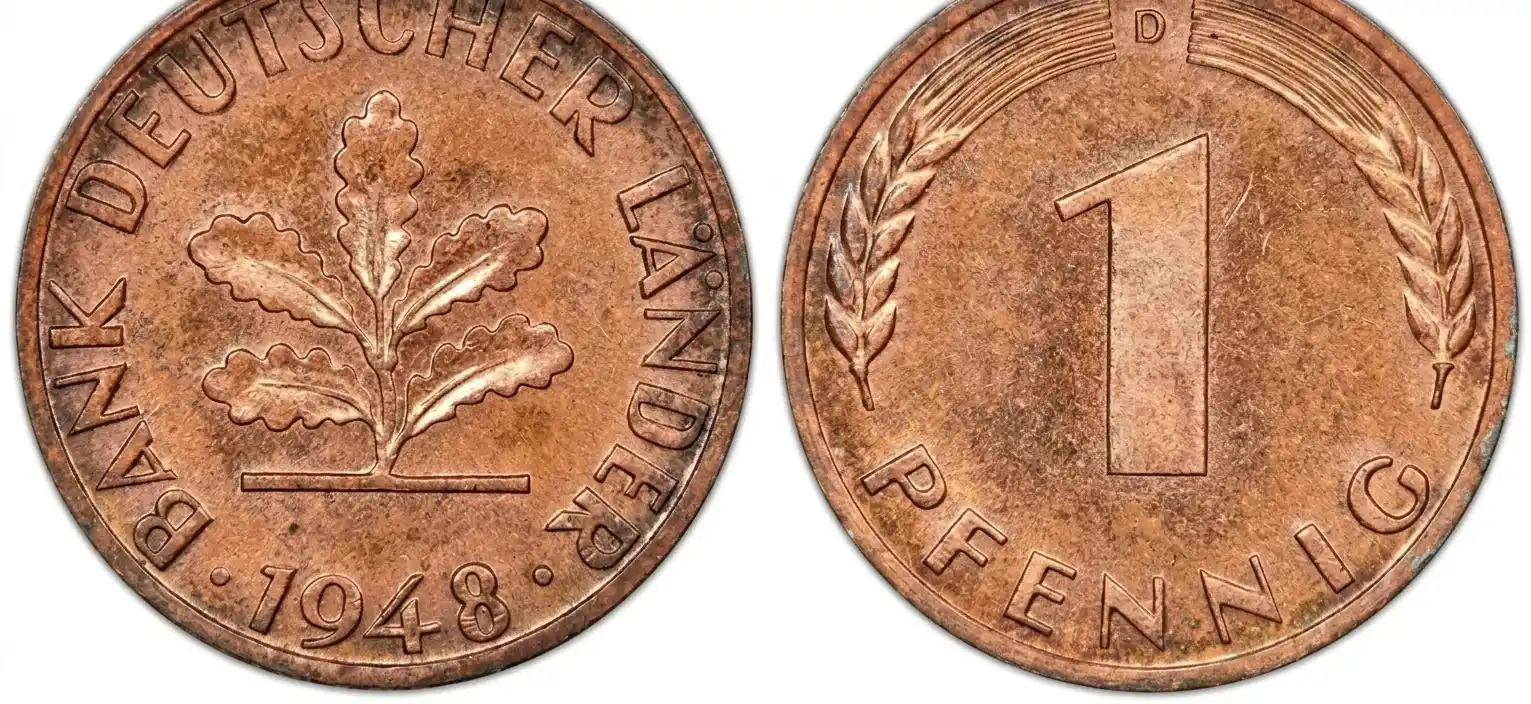
1 Pfennig 1948 — Mint D — first emission — €150
5 Pfennig 1967 — Mint G — €120
Price gaps between Very Fine and Uncirculated conditions reach 500% depending on the date.
Value for rare positions in twenty twenty-six increased by 4.2% compared to the previous year.
Demand for Third Reich coins remains steady provided no illegal symbols appear on trade platforms.
Price Trend Dynamics: Factor Analysis
Coin valuation does not represent a static number.
Appreciation for a collectible item follows specific market cycles.
Scarcity factor → Reduced market availability → Higher buyer competition → Price growth
Annual value increase percentages for various pfennig categories:
Rare die varieties — 7% annually
Graded coins in plastic holders — 12% annually
Common circulation coins — 0.5% annually
Mint sets — 3% annually
Inflation within the eurozone encourages capital movement into hard numismatic assets.
Liquidity for West German pfennigs exceeds the liquidity of East German coins.
Average sale time for a rare coin on the eBay platform is currently 6 days.
Classification of Mint Errors and Their Worth
Manufacturing mistakes create unique objects for study.
Technological oversight at German mints usually prevented errors from entering circulation.
Identified deformation types:
Struck on a blank intended for a different denomination — €1500 and higher
Double strike with rotation — from €400
Missing date digits caused by die grease — €50
Image shift exceeding 25% — €250
Finding an error within old bank rolls increases the total lot value.
Numismatists classify such coins using the term Fehlprägungen.
Counterfeit mint errors are detected through metal composition testing.
Design Evolution Chronology 1948–2001
Coin aesthetics reflected the political climate of the country.
Initial issues carried the inscription Bank Deutscher Länder.
1948–1949 → Emission under the control of Allied authorities 1950 → State name change to Bundesrepublik Deutschland 1990 → Expansion of the circulation area to eastern territories 2002 → Withdrawal from circulation
Oak leaf imagery found on lower denominations symbolizes German forests.
Rye stalks featured on 5 and 10 pfennigs point to the agricultural economy.
The woman planting an oak on the 50 pfennig coin represents German reconstruction.
Comparative Scarcity Analysis by Year and Mint
Certain combinations of dates and letters appear very infrequently.
Year | Mint Mark | Mintage (thousands) | Current Price MS60 |
1948 | D | 10000 | €25 |
1949 | G | 11400 | €18 |
1951 | G | 2000 | €85 |
1952 | J | 2500 | €45 |
1953 | G | 1500 | €110 |
Hamburg mintage totals traditionally exceeded the production levels in Karlsruhe.
Destruction of worn coins by the central bank reduces the actual number of surviving pieces.
Survival rates for coins in UNC condition represent less than 1% of the original mintage.
Physical Preservation and Storage Methods
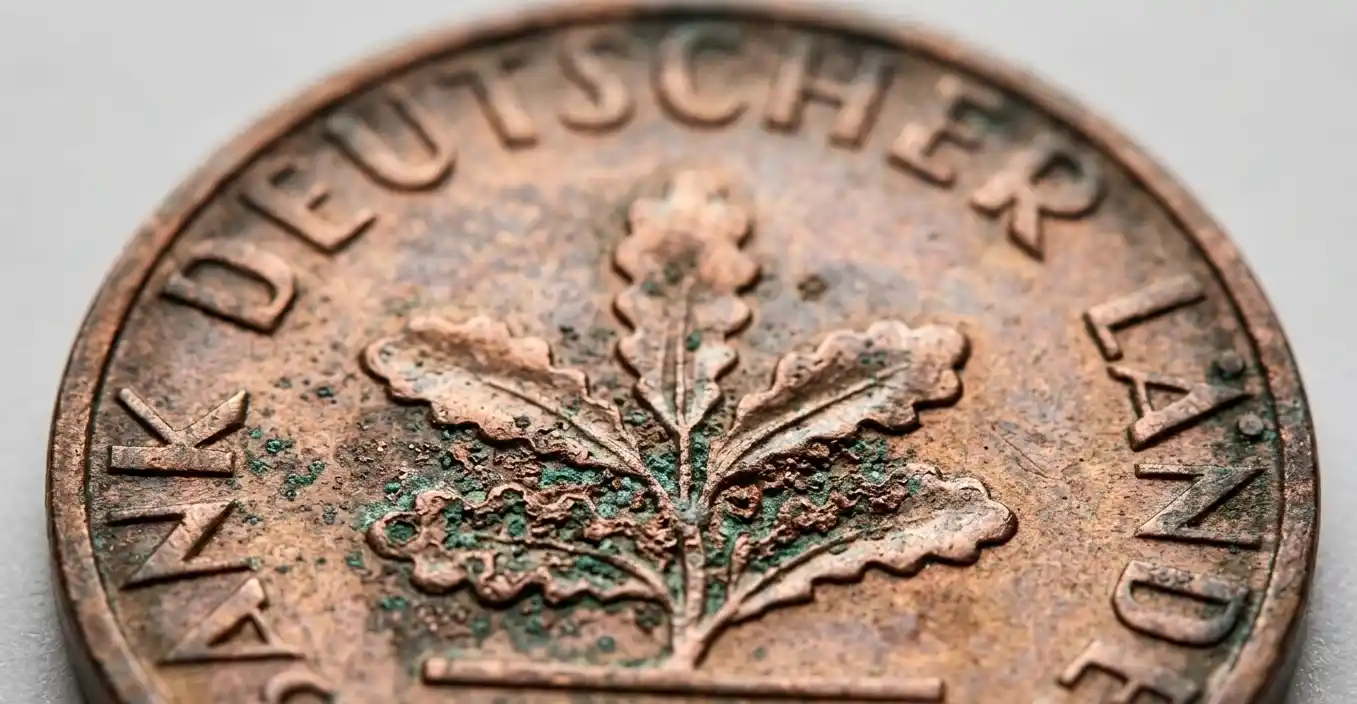
Coin metal undergoes oxidation when contacting oxygen.
Steel with copper coating remains vulnerable to rust along the edge.
Collection maintenance rules:
Use of capsules made from inert plastic
Maintaining air humidity below 45%
Excluding contact with soft plastic containing oils
Temperature range between 18 and 22 degrees
Patina formation on copper pfennigs constitutes a natural process.
Even brown patina does not lower the overall grade.
Black corrosion spots decrease the object's value by 80%.
Evaluation and Grading Procedures
Professional certification confirms authenticity and preservation levels.
Rating agencies utilize an international seventy-point scale.
Evaluation sequence:
Authenticity verification using weight methods
Surface inspection with the coin identifier app free
Assigning a numerical index based on the Sheldon system
Sealing inside a hard plastic holder
Grading a coin worth €10 is not economically viable.
Minimum market price threshold for submitting to certification is €100.
Presence of a PL or Prooflike designation adds 30% to the price.
East German Pfennigs: Specific Differences
East German coins were manufactured using aluminum alloys.
Lightweight aluminum makes these coins fragile.
East German pfennig characteristics:
Material — Aluminum
Weight — 0.75 g for 1 pfennig
Symbols — Hammer and compass inside a grain wreath
Mint — Mostly Berlin (A)
Price for a rare aluminum pfennig from 1948 reaches €400.
Aluminum oxidation manifests as a white powdery coating.
Cleaning East German coins with harsh acids destroys the original mint luster.
Impact of Digitalization on the Market
Online registries simplify the search for rarity data.
Electronic catalogs update in real-time.
Information availability → Reduction in transactions at undervalued prices → Stabilization of market quotes
Mobile applications allow for instant coin identification via photography.
Automatic recognition accuracy reaches 98%.
Errors in mint mark identification are eliminated by modern software.
Historical Significance and Cultural Layer
The pfennig functioned as the basic unit of account for one thousand years.
The name originates from the Latin word pondus.
Accounting system transformation: 12 pfennigs = 1 shilling → 20 shillings = 1 pound (ancient period) 100 pfennigs = 1 mark (imperial and republic periods)
Oak symbolism on modern coins maintains continuity with nineteenth-century marks.
Numismatic collections serve as physical evidence of past inflation processes.
Weight reduction seen in historical coins indicates currency debasement by rulers.
Methods for Home Authenticity Testing
Self-verification minimizes the risk of purchasing copies.
Using precise tools is necessary for proper verification.
Verification toolkit:
Electronic scales with 0.01 g increments
Digital calipers
Neodymium magnet
Ultraviolet lamp for inspecting packaging
Weight discrepancy of 0.05 g indicates a casting or a different alloy.
Coin edges must have a sharp structure without mold seams.
The sound of a coin dropping on wood should be clear without rattling.